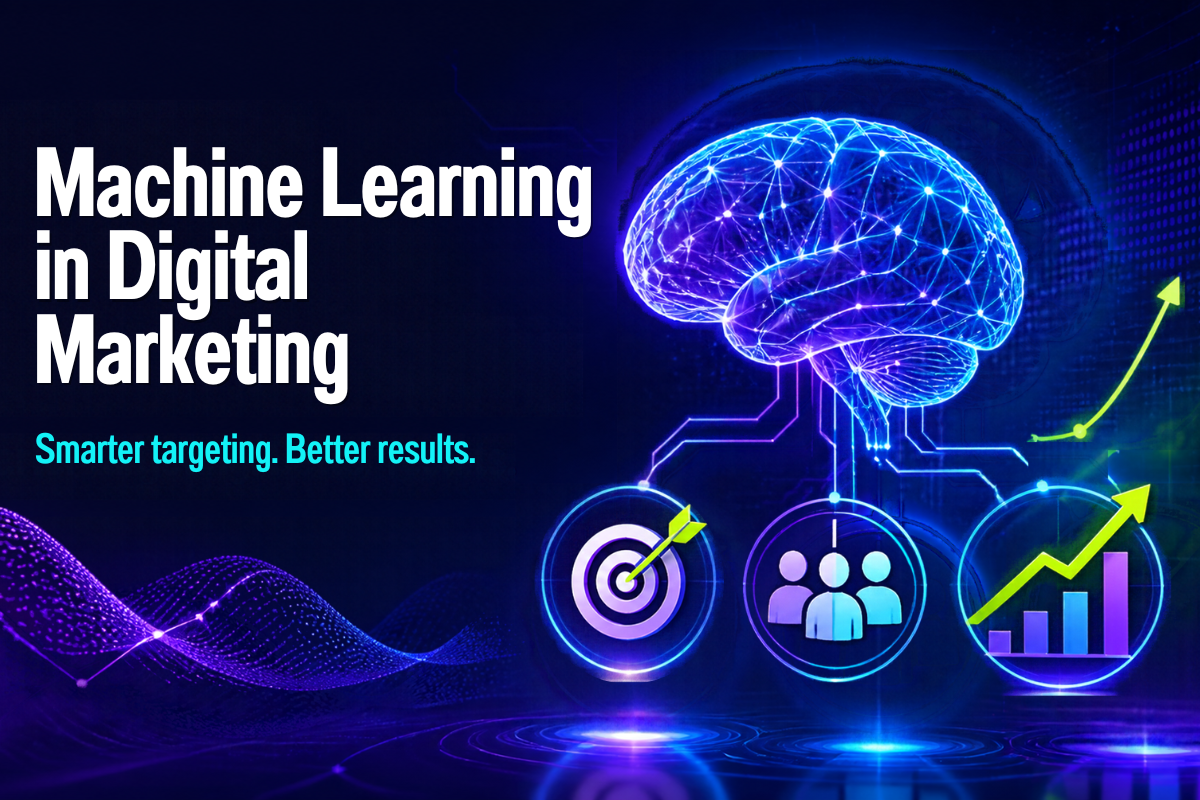
Every second, ad platforms make thousands of tiny decisions: who sees your ad, how much you pay, and which creative earns the click. No human team can test that many combinations by hand. A machine learning model can, and it gets smarter with every impression.
That is why machine learning in digital marketing has moved from buzzword to daily working tool. McKinsey estimates that generative AI alone could lift marketing productivity by an amount equal to 5% to 15% of total marketing spend. For advertisers, that is the difference between guessing and knowing.
In this guide, we explain what machine learning actually does for paid media, review 10 tools worth your attention, and show you how to choose the right one. If you want the broader strategy first, start with our AI digital marketing guide.
What Is Machine Learning in Digital Marketing?
Machine learning is a branch of artificial intelligence where algorithms learn patterns from data instead of following fixed rules. In advertising, those patterns include which users convert, which headlines win clicks, and which bids stay profitable.
The more clean data you feed a model, the better its predictions become. That is why conversion tracking quality matters more than any single campaign setting.
Here is where machine learning typically shows up in a campaign:
- Bidding: Predicting the value of each auction in real time.
- Audience targeting: Finding lookalike and high-intent users.
- Creative testing: Mixing headlines, images and formats automatically.
- Predictive analytics: Forecasting purchases, churn and lifetime value.
- Budget allocation: Shifting spend toward the channels that perform.
Why Digital Advertisers Are Adopting Machine Learning So Fast
Advertisers face rising competition, privacy changes and shrinking third-party data. Machine learning helps fill those gaps by modeling behavior instead of tracking every individual user.
The benefits we see most often:
- Faster optimization: Models react to signals in minutes, not days.
- Less wasted spend: Weak placements and audiences receive less budget.
- Better scale: One strategist can manage far more campaigns.
- Sharper insights: Predictive metrics show which users are likely to buy.
A note from experience: machine learning is not magic. In the paid campaigns we manage, the accounts that benefit most have accurate conversion tracking and enough conversion volume. Without those, automation simply optimizes toward the wrong goal faster.
The Top 10 Machine Learning Tools for Digital Advertisers
We grouped these tools by what they do best. Some are built into the ad platforms you already use, while others are specialist add-ons.
1. Google Ads Smart Bidding and Performance Max
Smart Bidding uses machine learning to set bids at auction time based on signals such as device, location, time of day and audience. Strategies include Target CPA, Target ROAS and Maximize Conversions. Performance Max extends this across Search, YouTube, Display, Discover, Gmail and Maps from one campaign.
Best for: Advertisers with steady conversion volume who want cross-channel reach.
2. Meta Advantage+
Meta’s Advantage+ suite automates audience, placement and creative decisions across Facebook and Instagram. Advantage+ shopping campaigns are designed around product catalogs and purchase goals.
Best for: E-commerce brands scaling social ads.
3. Google Analytics 4 Predictive Audiences
GA4 can estimate purchase probability, churn probability and predicted revenue. You can turn those predictions into audiences and push them to Google Ads. Eligibility depends on having enough event volume.
Best for: Teams that want to bid higher on users who are likely to buy.
4. Optmyzr
Optmyzr is an optimization platform for major ad networks. It offers automated audits, bid management, budget pacing and rule-based alerts. It is a practical way to add structure to your machine learning workflow.
Best for: Agencies and in-house PPC teams managing many accounts.
5. Madgicx
Madgicx focuses on Meta campaigns with AI-driven audience, budget and creative recommendations. Its reporting helps you see which creative elements drive results.
Best for: Advertisers heavily invested in Facebook and Instagram.
6. Albert.ai
Albert is an autonomous platform that plans, launches and optimizes campaigns across search, social and programmatic channels. It works best when budgets and data volume are large.
Best for: Larger advertisers that want hands-off cross-channel automation.
7. HubSpot AI Tools
HubSpot’s AI features support lead scoring, content drafting and campaign reporting inside a CRM. Closed-loop reporting connects ad spend to pipeline, not just clicks.
Best for: B2B and service businesses that want ads tied to revenue.
8. Salesforce Einstein
Einstein adds predictive scoring, send-time optimization and next-best-action recommendations to the Salesforce ecosystem.
Best for: Enterprises already running on Salesforce.
9. Adobe Sensei
Adobe Sensei powers features across Adobe Experience Cloud, including audience segmentation, anomaly detection and personalization at scale.
Best for: Enterprise brands with complex customer journeys.
10. Smartly.io
Smartly automates creative production, ad scaling and budget allocation across social platforms. It is built for brands running large catalogs or many creative variations.
Best for: Retail and e-commerce brands with high creative volume.
How to Choose the Right Machine Learning Tool
The best tool is the one that fits your data, budget and team. Use these checks before you commit.
Match the Tool to Your Data Volume
Native tools like Smart Bidding and Advantage+ need conversion data to learn. Start there before you pay for third-party software. If you only get a handful of conversions per month, focus on tracking and landing pages first.
Check Integrations and Transparency
A good platform connects to your CRM, analytics and ad accounts. It should also show you why it made a decision. Black-box reporting makes it hard to defend results to your leadership team.
Plan for Human Oversight
Machine learning needs guardrails: budget caps, brand safety rules and regular reviews. We treat automation as a fast junior analyst. It does the heavy lifting, but a strategist still sets direction and checks the work.
Common Mistakes We See with ML-Powered Advertising
These errors drain budgets more often than any algorithm flaw:
- Feeding bad conversion data: Counting low-value events as conversions teaches the model to chase the wrong users.
- Changing settings too often: Constant edits reset the learning period.
- Switching bidding strategies too soon: Models need weeks of data to stabilize.
- Ignoring creative quality: Automation cannot rescue a weak offer.
- Judging results in days: Give models time to learn before drawing conclusions.
How SRK WEBTECH Puts Machine Learning to Work for You
Tools only deliver when they are set up around your business goals. At SRK WEBTECH, we start with a tracking and data audit, then choose bidding strategies and tools that match your volume and margins.
We set guardrails, test creative in structured cycles and report on revenue, not vanity metrics. Our approach is data-driven and transparent, so you always know what is working and why.
If you are evaluating partners, you can also find us on Google Maps and learn more about our services at SRK WEBTECH.
Ready to turn machine learning into measurable growth? Contact us today, call us at [8961293724], or schedule a consultation with our team.
Conclusion
Machine learning has become the engine behind modern paid media. The 10 tools above cover bidding, audiences, creative, and predictive analytics, so there is an option for almost every budget.
The winning formula is simple: clean data, the right tool, and expert oversight. Start with the native platform features, measure honestly, and add specialist software only when your data supports it.
FAQs
What is machine learning in digital marketing?
It is the use of algorithms that learn from data to improve bidding, targeting, creative and forecasting. Instead of following fixed rules, the system adjusts as new data arrives.
Will machine learning replace digital marketers?
No. It automates repetitive optimization, but strategy, messaging, testing and quality control still need human judgment.
Do small businesses need paid machine learning tools?
Usually not at first. Google Ads and Meta already include powerful machine learning at no extra software cost. Add paid tools when your spend and complexity grow.
How much data do I need for ML-based bidding to work?
More is better. Platforms generally perform best with a steady flow of conversions each month, so strong tracking is the first priority.
How long before I see results?
Expect a learning period of a few weeks. We recommend avoiding major changes during that window and reviewing performance against your goals afterward.
📚 Explore the Rest of Our Digital Growth Series
Master every aspect of your online presence by exploring the other guides in our core marketing series: